London clinic invests in early detection of coronary disease
17 April 2008
The Clinical Imaging and Research Centre based at The Wellington Hospital in north London, a leading private hospital for cardiac care, has installed a Somatom Definition Dual Source CT, Symbia T6 Spect CT and ultrasound scanners from Siemens in its multipurpose cardiac imaging and research centre.
Siemens delivered a turnkey solution by accommodating the Somatom Definition CT scanner and Symbia T6 in adjacent rooms so that they can work simultaneously and patients can be transferred easily from one scanner to the other. By bringing together nuclear medicine and CT imaging, co-localised physiological images of the patient anatomy are generated, which improves the diagnostic quality of nuclear medicine procedures.
The Somatom Definition Dual-Source CT scanner has a true temporal resolution of 83 milliseconds, allowing the system to image the most clinically challenging cardiac patients without beta blockers and independent of the heart rate. The systems will expand the current CT and nuclear medicine service delivery including dual energy CT on the Somatom Definition and general nuclear medicine on the Symbia T6.
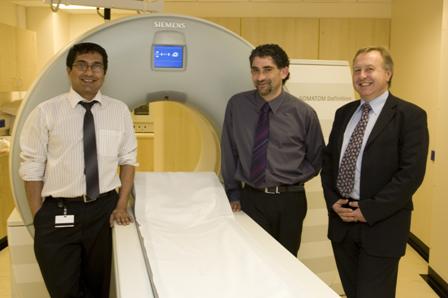
Dr Shree Venuraju,
Cardiology Research Registrar; Stanley Muscat, Imaging Manager;
and Vince Golledge, Siemens Regional Sales Manager with the
SOMATOM Definition
Dual Source CT
at the Wellington Hospital
The Clinical Imaging and Research Centre and British Cardiac Research Trust (BCRT) has invested in the latest technology to assist its cardiologists with early detection of coronary disease and to support its pioneering patient research projects.
Professor Lahiri, Consultant Cardiologist at The Wellington Hospital commented: “We needed to marry the requirements of our research facility with the needs of our clinical practice. This meant we needed scanners that could maintain high volume throughput, while offering the highest precision imaging that can support in-depth research capabilities. Siemens was the obvious choice for us, due to its long standing commitment to developing the latest technology that promotes efficient examination and achieves superior image quality.”
The group is ready to begin sophisticated trials to aid in rapid and accurate diagnosis of heart disease in patients presenting to the NHS ‘chest pain clinics’. This is part of the Randomised Trial for Objective Diagnosis of Chest Pain using Alternative Technologies (RADICAL Trial). This will pave the way for improved diagnosis and cost-effective treatment.
